100 AMP.
200 AMP.WHAT DOES YOUR HOME ACTUALLY NEED?
A bigger electrical service isn’t automatically a better decision. The right one depends on the condition of your equipment, the loads in your home, and what you plan to add.
Before committing to a panel replacement or service upgrade, here’s how to tell the difference between a capacity problem and a problem that needs a different solution.
Start with the answer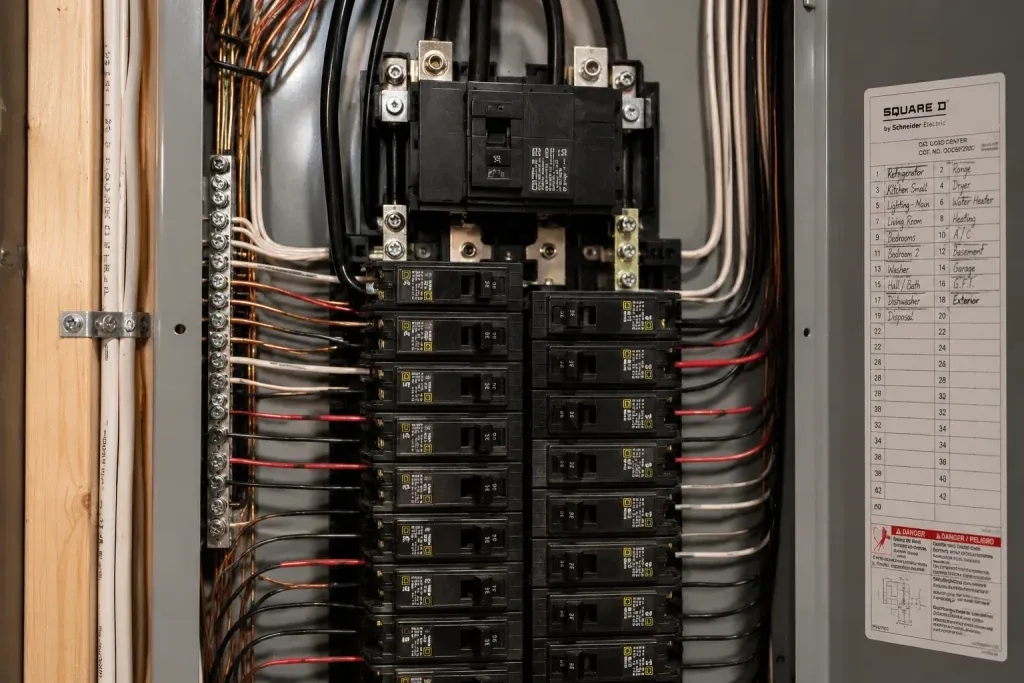
100 AMPS MAY BE ENOUGH.
A 100-amp electrical service can be sufficient for a house with modest electrical demand. A 200-amp service can make sense when the existing loads or planned additions call for more capacity. Neither choice is determined by the house’s age alone.
Compare two houses of similar size. One uses gas for space heating, hot water, and cooking. The other relies on electric heat, an electric range and dryer, and may add a Level 2 EV charger. They can have very different electrical demands even with similar square footage.
That’s why the correct starting point is an electrical load calculation, along with an assessment of the actual equipment. A recommendation based only on square footage or the size of a neighbor’s panel is incomplete.
BREAKER SPACE IS NOT SERVICE CAPACITY.
One of the easiest ways to buy more electrical work than you need is to confuse three separate questions.
A panel that’s full may still have available capacity.
A service panel can run out of approved breaker positions without running out of available electrical capacity. If a load calculation supports the existing service, a correctly designed subpanel might provide the additional circuit spaces needed.
A subpanel does not create more capacity. It distributes power from the same existing service.
Adding breaker ratings isn’t a load calculation.
Adding up the numbers on all the breakers in a panel can produce a total far above the main breaker rating. That alone doesn’t indicate an overloaded service: appliances don’t necessarily operate at their circuit-breaker ratings, and applicable calculations account for the nature of the connected loads.
The U.S. Department of Energy specifically distinguishes physical breaker space from electrical capacity in its home-electrification guidance.
WHEN MORE CAPACITY MAKES SENSE.
An upgrade should solve a documented problem or support a defined plan. These are the conditions worth discussing with your electrician.
You’re adding significant electrical equipment.
Level 2 EV charging, electric heating, a large addition, a hot tub, or conversion from gas to electric appliances may justify reevaluating service size. But none of these projects automatically requires 200 amps. The answer depends on the connected equipment, existing load, and any permitted load-management approach.
Ask for an assessment before choosing equipment or committing to an upgrade.
The panel needs replacement, even if the service capacity is enough.
Corrosion, heat damage, damaged connections, or incompatible equipment can warrant corrective work independent of amperage. Replacing a deteriorated 100-amp panel does not always require increasing the service to 200 amps.
This is why panel replacement and service-capacity upgrades shouldn’t be treated as interchangeable terms.
One breaker keeps tripping.
A frequently tripped breaker can indicate an overloaded branch circuit, a fault, or trouble with equipment connected to that circuit. It does not, by itself, prove the whole house needs a larger service. The right response is to identify the cause of the trip.
If there’s burning odor, smoke, active sparking, or signs of severe overheating, keep clear of the affected equipment and seek immediate professional or emergency assistance. Do not repeatedly reset a breaker that continues to trip. See the Electrical Safety Foundation International’s warning signs.
There isn’t room for another breaker.
The existing service might still support the additional electrical load. A subpanel can be an appropriate way to distribute circuits where capacity and installation conditions allow, but it cannot increase the total supply capacity.
The panel label says 200 amps. Does that mean your service is 200 amps?
Not necessarily. A panel enclosure’s rating does not, by itself, establish the rating of the entire service. The main disconnect, conductors, and associated service equipment need to be evaluated together. Don’t assume the largest number visible on a label answers the question.
These can be different scopes, different costs, and different solutions.
CAPACITY IS ONE QUESTION. CONDITION IS ANOTHER.
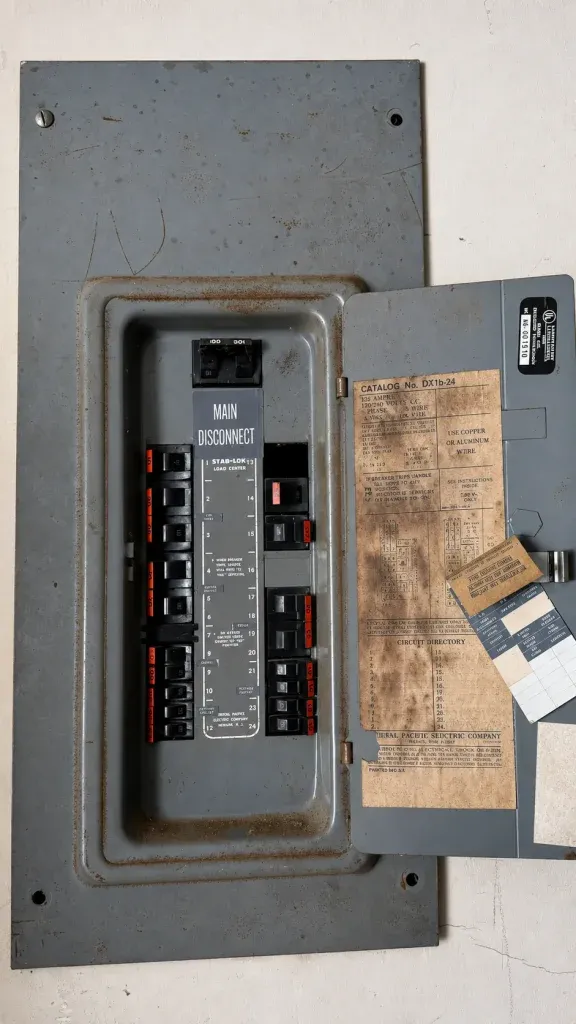
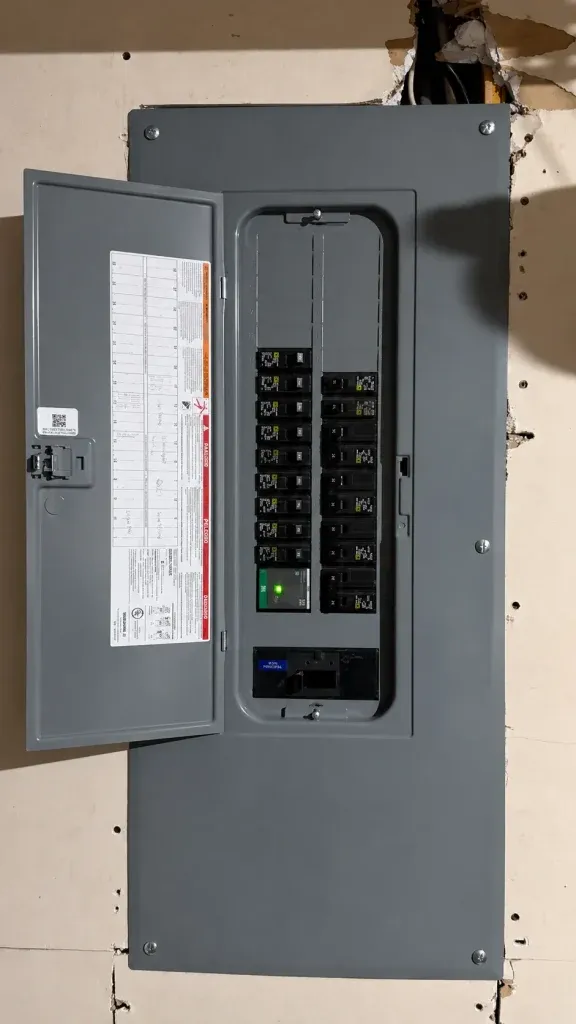
These are photographs from a Calvary Electric panel replacement project: the existing Federal Pacific panel and the new load center after replacement. They document the equipment change. A photograph alone cannot establish whether a different property’s service needs more amperage.
ASK FOR A REASON, NOT JUST A NUMBER.
Whether you’re considering a panel replacement or an increase from 100 to 200 amps, the estimate should explain what problem the work solves.
Verify the existing service.
The electrician should identify the actual service rating and examine the relevant panel, main disconnect, conductors, and associated equipment. A visible label alone may not tell the whole story.
Calculate current and proposed electrical demand.
The calculation should account for the home as it exists and for the equipment you plan to add. Proper load calculations use applicable code methods; they aren’t performed by totaling breaker handles.
Separate repairs, panel replacement, and service upgrades.
Ask whether a new circuit, an appropriate subpanel, a like-capacity replacement, or a larger service actually addresses the documented issue. The proposed scope should match the finding.
Understand the full cost and approval process.
The price depends on site conditions and scope: panel and meter equipment, service conductors, grounding and bonding, access, permits, inspections, and utility coordination may all affect the project. Two bids called “panel upgrades” may cover very different work. Ask what’s included and whether an outage will be required.
What about permits and inspections?
For work in Frederick County, Maryland, the county’s electrical permitting guidance explains when permits are required and who may apply. The permitting authority for a particular address should be confirmed before work begins.
The City of York, Pennsylvania, states that electrical projects require permits. Its Bureau of Permits and Inspections provides the city-specific process. Requirements elsewhere in York County, Adams County, and other municipalities must be checked with the applicable authority; city requirements aren’t automatically countywide.
WHAT PEOPLE ASK BEFORE THEY UPGRADE.
01 Is 100-amp service outdated? +
Not necessarily. It may still be adequate for a home with modest electrical demand. Whether it is suitable depends on the actual service rating, equipment condition, calculated loads, and planned changes.
02 Can I install an EV charger with 100-amp service? +
Possibly. The charging equipment, existing electrical loads, and any approved energy-management method determine what’s feasible. An electrician should evaluate the loads before an upgrade is assumed necessary.
03 Will a 200-amp upgrade lower my electric bill? +
Not by itself. More service capacity allows the system to supply a greater electrical load; it does not automatically reduce the energy consumed by appliances.
04 Does a 200-amp panel mean the home has 200-amp service? +
No. The panel’s maximum rating alone doesn’t establish the rating of the service feeding it. Other equipment and conductors must be considered.
05 Can a subpanel replace a service upgrade? +
Only when the service already has sufficient capacity and the additional circuit arrangement is suitable. A subpanel provides distribution space, not more incoming capacity.
06 Should I upgrade before installing a standby generator? +
Not automatically. Generator sizing, selected backed-up loads, transfer equipment, and electrical integration require their own planning. Learn more about Calvary’s generator installations.
07 What should I ask when comparing panel-upgrade estimates? +
Ask which deficiency or load requirement the work addresses, whether the proposal includes a service-capacity increase, and what permit, inspection, service-equipment, and utility coordination items are included.
THE RIGHT CAPACITY.
THE RIGHT CALL.
Planning an upgrade or trying to understand the panel you already have? Start with an evaluation of the actual system, not a guess.